
SB 553 is law. Is your California portfolio compliant?
Every California employer is now required to have a Workplace Violence Prevention Plan — with employee training and a violent incident log. Here's what's actually required, what's at stake, and how to audit your portfolio in 10 minutes.
SB 553 in plain English
What the law requires, what gets multifamily operators caught off guard, and how to operationalize your plan in practice.
The three core requirements
Effective July 1, 2024, every California employer must have a Workplace Violence Prevention Plan (WVPP). For multifamily operators, the plan must include three documented elements.
Incident Log
A written record of all workplace violence incidents, including near-misses and threats. Must include date, time, location, description, and people involved. Retained for at least five years.
Employee Reporting
A clear, documented mechanism for employees to report incidents — anonymously if needed — without fear of retaliation. The mechanism must be communicated and accessible to all employees.
Violent Incident Log
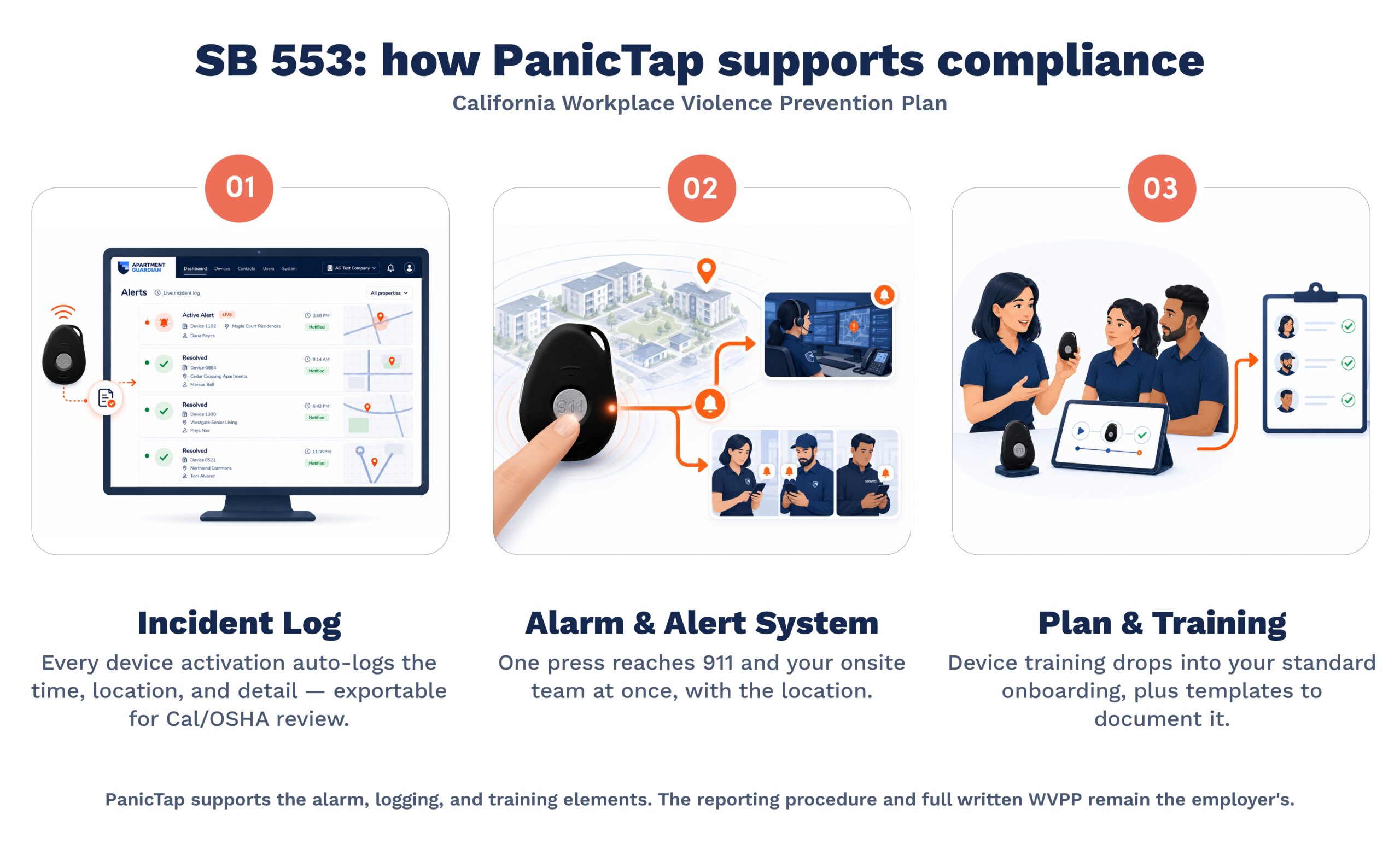
A detailed, retained record of every workplace violence incident — which is far easier to maintain when employees have a fast, consistent way to alert others when they need emergency assistance — particularly when working alone or in remote areas of a property.
Get the SB 553 Compliance Checklist
A practical self-audit you can run in 10 minutes. Designed specifically for multifamily property management operators. PDF.
- The five sections of a compliant WVPP, broken down line by line
- Yes/no checkboxes for each requirement so you can score yourself
- The five "working alone" scenarios most portfolios miss
- Cal/OSHA penalty schedule — what you're actually exposed to
- Next steps for closing common gaps
Download the checklist
Free. PDF delivered instantly and emailed to you.
Your information is used only to deliver the checklist and follow up about Apartment Guardian. We don't share it. Unsubscribe any time.
The working-alone scenarios most portfolios miss
SB 553 requires you to identify and address the hazards your employees face working alone or in remote areas. For multifamily operators, here's where the law applies that most plans overlook.
Showing a vacant unit
A leasing agent meeting a prospective resident — often someone they've never met — in an unoccupied apartment, sometimes in a remote part of the property. A lone-worker hazard your plan must address.
Maintenance service calls
A maintenance technician entering a resident's unit alone, sometimes responding to escalated complaints or after-hours emergencies. A lone-worker hazard your plan must address.
After-hours office work
A community manager closing the office, walking to their car through unmonitored parking, or addressing a resident concern alone after dark. A lone-worker hazard your plan must address.
Property walks
Regional managers and community managers conducting property walks through parking structures, pool areas, or vacant unit clusters. A lone-worker hazard your plan must address.
Eviction-related contact
Any staff interaction with residents under financial or legal stress, including delivering eviction notices or related communications. A lone-worker hazard your plan must address.
Resident dispute response
A staff member responding alone to a resident complaint, noise call, or dispute — particularly in evenings or weekends when other staff aren't onsite. A lone-worker hazard your plan must address.
Cal/OSHA penalties stack per location
For multi-property operators, the real exposure isn't a single fine — it's the same fine repeated at every non-compliant California site.
California law also allows Cal/OSHA to presume violations are enterprise-wide when a pattern is found at multiple worksites — meaning one citation can trigger citations across your portfolio.
California SB 553: What Property Management Companies Need to Know
The full-length breakdown of SB 553 — enforcement history, court interpretations to date, and what we're seeing across our 200+ partner companies operating in California.
See how fast your portfolio could be SB 553 compliant
Request a 15-minute walkthrough with our team. We'll review your portfolio — the number of properties, the working-alone scenarios most relevant to your staff, the timeline your team would need — and give you a specific deployment plan with dates.
What we cover: how Apartment Guardian satisfies each of SB 553's three core requirements, deployment timeline for your portfolio size, what your staff sees on day one, and the documentation you'd be able to show Cal/OSHA. That's it.
Get your compliance timeline
15 minutes. We'll reach out within one business day.
15-minute call. You'll leave with a specific deployment plan for your portfolio — even if you don't move forward with us.