
Safety is becoming a competitive advantage in multifamily.
Not because the work on your properties changed, but because what your teams expect from an employer did. The management companies treating staff safety as a workforce strategy are pulling ahead on retention, recruiting, and culture — and most of the industry hasn't noticed yet.
- Why it works: how safety turns into confidence, and confidence into performance
- What it looks like: a customer on the incident that changed how she works — and what she carries now
- Where it's going: the spending and legislation moving toward multifamily
Talk to us
Just want the research? Download the report →
Why she carries one now.
A customer talks about facing a violent incident at work with no way to call for help, and how having Apartment Guardian has changed her perspective since.
The Employee Safety Flywheel.
A lot of employee safety is still reactive — responding to an incident after it happens. But the research suggests organizations benefit from being proactive. Employees who believe their organization supports them report greater confidence doing their work, and that confidence shows up in how they handle tours, maintenance requests, and residents. Over time it compounds into culture, retention, and operational performance.
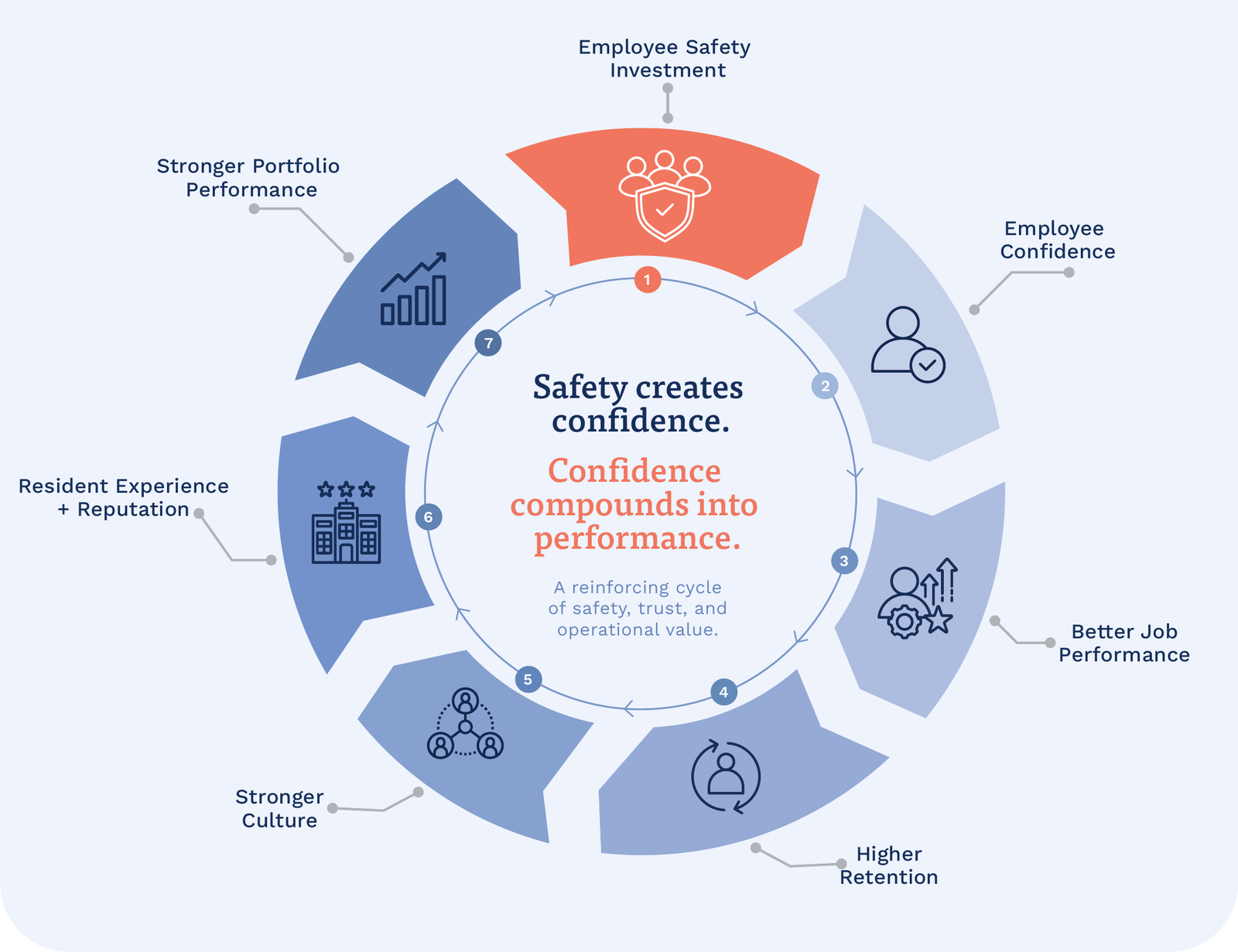
- 1Employee safety investment
- 2Employee confidence
- 3Better job performance
- 4Higher retention
- 5Stronger culture
- 6Resident experience + reputation
- 7Stronger portfolio performance
Instead of asking “How many emergencies did we prevent?” the more useful question may be: “How does our approach to employee safety influence the confidence employees bring to work every day?”
How safety turns into performance.
Safety programs are usually judged by what doesn't happen, which makes them hard to defend at budget time. There's a second effect that runs on things you can actually observe: people who believe their employer takes their safety seriously work with more confidence, and that shows up in your operations. Ninety seconds on how it compounds.
She isn't an outlier, and the market knows it.
For two decades, multifamily innovation centered on operations and the resident experience. A quieter shift is now underway across Corporate America: employee safety is becoming a strategic capability that shapes retention, culture, and employer brand. The data says multifamily is at the start of the same curve — the one revenue management and centralized leasing rode from differentiator to table stakes.
EHS = Environment, Health & Safety
Organizations don't invest at this scale unless they believe safety creates measurable business value.
Three forces converging on multifamily.
52% of onsite staff say feeling safe significantly affects whether they stay; more than half have changed or avoided parts of their job over safety concerns; nearly 1 in 3 report no meaningful safety support.
California's SB 553 is already in effect. Washington now mandates panic buttons for lone workers. 100+ workplace-violence bills are moving in 27 states.
Early movers are turning safety into a recruiting and retention strength — the same way operational tech became a differentiator a decade ago. Laggards will be catching up under a deadline.
The Employee Safety Maturity Model.
Every organization invests in employee safety. The difference is rarely whether they care — it's how intentionally that safety is managed. These are the five stages we see, from informal practice to safety as a genuine competitive advantage.
Competitive Advantage
Safety strengthens employer brand, recruiting, leadership, and operations.
Integrated
Technology, metrics, check-ins, emergency response, and executive visibility.
Operational
Lone-worker protocols, documented procedures, buddy systems, and training.
Policy
Basic training, incident reporting, and written procedures.
Reactive
Company phones, informal practices, and “call if you need help.”
Progression requires moving from informal practices to integrated safety systems.
Everything else worth a look.
The New Safety Advantage
The full executive report on how employee safety is becoming a competitive advantage in multifamily. No email needed.
Download the PDF →What 400 onsite professionals told us
The findings from our blind, third-party survey of leasing consultants, maintenance techs, and community managers.
See the findings →How PanicTap works
A closer look at the device your team would carry — one press, direct to 911, with location, and no app to open.
See the product →How we work with portfolios
Pricing, rollout, and portfolio-wide reporting — how deployment works across every property you manage.
See portfolio solutions →Fifteen minutes with our CEO.
If you'd rather skip the back-and-forth, book time directly. We'll walk through what this would look like at your properties — device counts, rollout, and pricing for your portfolio.
No sales team, no discovery call before the real call. You'll be talking to the person who runs the company.

The question is no longer whether — it's whether you're keeping pace.
Book fifteen minutes and we'll walk through what this looks like across your portfolio.
Book a demo